
European digital sovereignty – but no adequate financial support for students in Germany?

Present discussions about European Digital Sovereignty underline the fact of an almost complete dependence of Europe and in particular of Germany on US technology – regarding

  • shear computational power (supercomputers, data centers),
  • classic IT, office and ERP applications (dominated by Microsoft, Google, Meta, …)
  • as well as AI models and related computational capacities
  • and, last but not least, the combination of robotics and defense systems with AI.

The standard recipe is a call for money to build more computation centers on European soil.

Actually, most of such centers presently under construction are planned to be eventually used by US companies. This is a sign of schizophrenia of European and German politicians or – even worse – a total lack of understanding of what happens in the fields of IT/AI and of what digital sovereignty really requires. Certainly not more data centers of Google, Microsoft or Meta in Germany. At least, this should not be a top priority item on an agenda for European independence of US monopolists.

Related concerns of European experts working in the fields of IT and AI culminated last week in the publication “https://europe2031.ai/“. The paper and the scenario described in it was triggered by the present failure of European governments to take and scale counter-measures against a coming US-dominance in the little remaining interval of time – if there is any at all. Visitors of this blog have probably read the paper, already.

From my perspective as a former IT consultant, I want to add three points which the scenario in the “Europe31.ai” paper does not cover to the extent these points deserve.

The first point is “education“:

AI is predominantly the result of certain types of SW, the development of artificial neural networks, the theory of artificial neural networks and advanced ideas about learning and learning algorithms. But, and this is sometimes totally underestimated, AI is also based on a lot of mathematics (in particular regarding Linear Algebra, analysis of data distributions in multiple dimensions, differential geometry, theory of graphs, optimization problems and advanced statistics). If you do not believe it, take a regular look at the papers published by American and Chines universities.

Top hardware is also an important aspect, but as China has shown with its recent CPU-based supercomputer LineShine and “DeepSeek” not a predominant factor. You can build sufficient supercomputer power also based on previous generations of hardware. What is much more important is the bundling and focusing of efforts in the field of AI – as well as the support of administrative institutions of solution oriented thinking and start-ups. Regarding these points we have, unfortunately, a lot to learn from China and investment companies in the US.

And: As in any high-tech field, real progress in the field of Machine Learning and LLM-based AI was and is achieved by clever ideas.

Proof: Consider the impact of transformer based neural networks on the development of present LLM systems. One idea, enormous consequences. And new emerging tech giants.

However and naturally: Clever ideas in turn require educated people.
Consequence: European AI Sovereignty requires at least as much investment in the education of people as in hardware.

Now, compare this with the fact that the present conservative government of Germany plans NOT to rise the state’s budget for supporting and helping students (Bafög) who do not have rich parents or parents with academic background.

A rise in support for extremely high costs for student apartments in German cities and a general increase of the support sum according to the inflation rate has been declined by a minister who – according to the press – made a paid career in their party and jobs in attached organizations already during their years as students; for related criticism see e.g. here, here and here and many more press articles. Its a shame – and I find no other word for it.

The decline came, although the level of financial support for students had and has already for several years been below minimum social standards guaranteed to other groups of citizens in Germany.

The obvious stupidity of such a budget planning remembers strongly of the Kohl era when theoretical physicists were told that Germany did not need theoretical researchers, but application oriented engineers. As if this had ever been a contradiction … My first diploma exam (in astrophysics) started with such a statement of the examining professors – uttered with a grain of pity for my generation. 15 years later the very same economy (not science) advisors, who once had told Kohl their “wisdom” about German engineering, suddenly found out that Germany did not receive enough Nobel prizes and that the best educated academic people had left Germany to work abroad. And advised chancellor Merkel to start initiatives on theoretical education and research. Well done …

Well, as a relatively old person with a PhD in physics, who can look back on more than 35 professional years in IT, you automatically think of the 5 apes in action, which unfortunately have become so characteristic of conservative German governments during the last 3 decades:

(1) Don’t hear and listen (to warnings of scientists), (2) don’t see (but ignore obvious developments in high tech realms), (3) don’t speak (about problems and long term strategy or e.g. about the self-inflicted dependency on Russian gas during the Merkel period and avoid any discussion about not having invested e.g. in digitization and AI), (4) don’t understand (because a substantial lack of MINT scientists among politicians), (5) don’t pick up ideas beyond a conservative ideology of the last century (let the market alone do its job).

As an elderly, rather conservative person, I do not utter this criticism lightheartedly. But the politicians of my generation (Merkel era) have totally failed to make my country, Germany, fit for the challenges of the time once called “future” – which now is the present time. Not to speak of today’s future …
Continue reading

We humans confabulate, too – not only AI

As a scientist you have to learn and accept that our perception of the world and of the rules governing it may reflect more of our genetically designed and socially acquired prejudices than reality. Scientist go through a long training to mistrust our prejudices. They instead try to understand reality on a deeper level of experimental tests combined with the building of theories and verifiable predictions. On this background I want to discuss a specific aspect in the presently heated debate about the alleged dangers of A(G)I. An aspect which I think is at least in parts misunderstood and not grasped at its full extend.

A typical argument in the discussion, which is used to underline a critical view on AI, is: “AI as e.g. in the form of GPT4 makes things up. Therefore, we cannot trust it and therefore it can be dangerous.” I do not disagree. But the direction of the critics misses one important point: Are we humans actually better?

I would clearly say: Not so much as we like to believe. We still have a big advantage in comparison with AI: As we are embedded into the physical world and interact with it we can make clever experiments to explore underlying patterns of cause and action – and thus go beyond the detection of correlations. We also can test our ideas in conversations with others and in confrontation with their experiences. Not only in science, but in daily social interaction. However, to assume that we humans do not confabulate is a big mistake. Actually, the fact that large language models (and other models of AI) often “hallucinate” makes them more similar to human beings than many of newspaper journalists are willing to discuss in their interviews with AI celebrities.

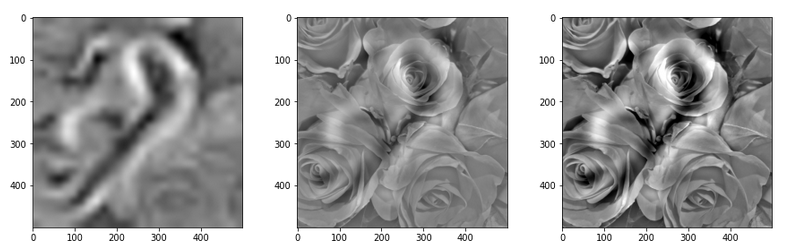
Illustration: “Hallucinations” of a convolutional network trained on number patterns when confronted with an image of roses

Experiments in neurosciences and psychology indicate that we human beings probably confabulate almost all the time. At least much more often than we think. Our brain re-constructs our perception of the world according to plausibility criteria trained end developed both during evolution of mankind and during our personal life. And the brain presents us manipulated stories to give us a coherent and seemingly consistent view upon our interactions with reality and the respective time-line added to our memories.

You do not believe in a confabulation of our brain? Well, I do not want to bore you with links to a whole bunch of respective literature published during the last 3 decades on this subject. Sometimes simple things make the basic argument clear. One of these examples is an image that got viral on social media some years ago. I stumbled across it yesterday when I read an interview of the Quanta Magazine with the neuroscientist Anil Seth about the “nature of consciousness”. And I had a funny evening afterward with my wife due to this picture. We had a completely different perception of it and its displayed colors.

The image is “The dress” of Cecilia Bleasdale. You find it in the named and very informative interview of the Quanta Magazine. You also find it on Wikipedia. I refrain from showing it, as there may be legal right issues. The image displays a skirt.

A lot of people see it as an almost white skirt with golden stripes. Others see it as a blue skirt with almost black stripes. Personally, I see it as a lighter, but clearly blue skirt with darker bronze/golden stripes. But more interesting: My wife and I totally disagreed.

We disagreed on the colors both yesterday night and this morning – under different light conditions and looking at the image on different computer screens. Today we also looked at hex codes of the colors: I had to admit that the red, green, blue mixture in total indicates much darker stripes than I perceive them. But still the dominant red/green combination gives a clear indication of something of a darker gold. The blue areas of the skirt are undisputed between me and my wife, although I seemingly perceive it in a lighter shading than my wife.

This is a simple example of how our brain obviously tells us our own individual stories about reality. There are many other and much more complex examples. One of the most disputed one is the question of whether we really control our intentional behavior and related decisions at a period around the decision making. A whole line of experiments indicates that our brain only confabulates afterward that we were in control. Our awareness of decisions made under certain circumstances appears to be established some hundred milliseconds after our brain actually triggered our actions. This does not exclude that we may have a chance of control on longer timescales and by (re-) training and changing our decision making processes. But on short timescales our brain decides and simply acts. And this is good so. Because it enables us to react fast in critical situations. A handball player or a sword fencer does not have much time to reflect his or her actions; sportsmen and sportswomen very often rely on trained automatisms.

What can we be sure about regarding our perceptions? Well, physical reality is something different than what we perceive via the reaction of our nerve system (including the brain) to interactions with objects around our bodies and resulting stimuli. Or brain constructs a coherent perception of reality with the help of all our senses. The resulting imagination helps us to survive in our surroundings by permanently extrapolating and predicting relatively stable conditions and evolution of other objects around us. But a large part of that perception is imagination and our brain’s story telling. As physics and neuroscience has shown: We often have a faulty imagination of reality. On a fundamental level, but often enough also on the level of judging visual or acoustic information. Its one of the reasons why criminal prosecutors must be careful with the statements of eye-witnesses.

Accepting this allows for a different perspective on our human way of thinking and perceiving: Its not really me who is thinking. IT, the brain – a neural network – is doing it. IT works and produces imaginations I can live with. And the “I” is an embedded entity of my imagination of reality. Note that I am not disputing a free will with this. This is yet another and more complex discussion.

Now let us apply this skeptical view on human perception onto today’s AI. GPT without doubt makes things up. It confabulates on the background of already biased information used during training. It is not yet able to check its statements via interactions with the physical world and experiments. But a combination of transformer technology, GAN-technology and Reinforcement Learning will create new and much more capable AI-systems soon. Already now interactions with simulated “worlds” are a major part of the ongoing research.

In such a context the confabulations of AI-systems make them more human than we may think and like. Let us face it: Confabulation is an expected side aspect on our path to future AGI-systems. It is not a failure. Confabulation is a feature we know very well from us human beings. And as with manipulative human beings we have to be very careful with whatever an AI produces as output. But fortunately enough AI-systems do not yet have an access to physical means to turn their confabulations into action.

This thought, in my opinion, should gain more weight in the discussion about the AI development to come. We should much more often ask ourselves whether we as human beings fulfill the criteria for a conscious intelligent system really so much better than these new kinds of information analyzing networks. I underline: I do not at all think that GPT is some self-conscious system. But the present progress is only a small step at an early stage of the development of capable AI. Upon this all leading experts agree. And we should be careful to give AI systems access to physical means and resources.

Not only do researchers see more and more emergent abilities of large language networks aside those capabilities the networks were trained for. But even some of the negative properties as confabulation indicate “human”-like sides of the networks. And there are overall similarities between humans and some types of AI networks regarding the basic learning of languages. See a respective link given below. These are signs of a development we all should not underestimate.

I recommend to read an interview with Geoffrey Hinton (the prize-winning father of back-propagation algorithms as the base of neural network optimization). He emphasizes the aspect of confabulation as something very noteworthy. Furthermore he claims that some capabilities of today’s AI networks already surpass those of human beings. One of these capabilities is obvious: During a relatively short training period much more raw knowledge than a human could process on a similar time scale gets integrated into the network’s optimization and calibration. Another point is the high flexibility of pre-trained models. In addition we have not yet heard about any experience with multiple GPT instances in a generative interaction and information exchange. But this is a likely direction of future experiments which may accelerate the development of something like an AGI. I give a link to an article of MIT Technology Review with Geoffrey Hinton below.

Links and articles

https://www.quantamagazine.org/ what-is-the-nature-of-consciousness-20230531/
https://slate.com/ technology/ 2017/04/ heres-why-people-saw-the-dress-differently.html
https://www.theguardian.com/ science/ head-quarters/ 2015/feb/27/ the-dress-blue-black-white-gold-vision-psychology-colour-constancy
https://www.technologyreview.com/ 2023/05/02/ 1072528/ geoffrey-hinton-google-why-scared-ai/
https://www.quantamagazine.org/ some-neural-networks-learn-language-like-humans-20230522/